
The Framework

Caring Authority

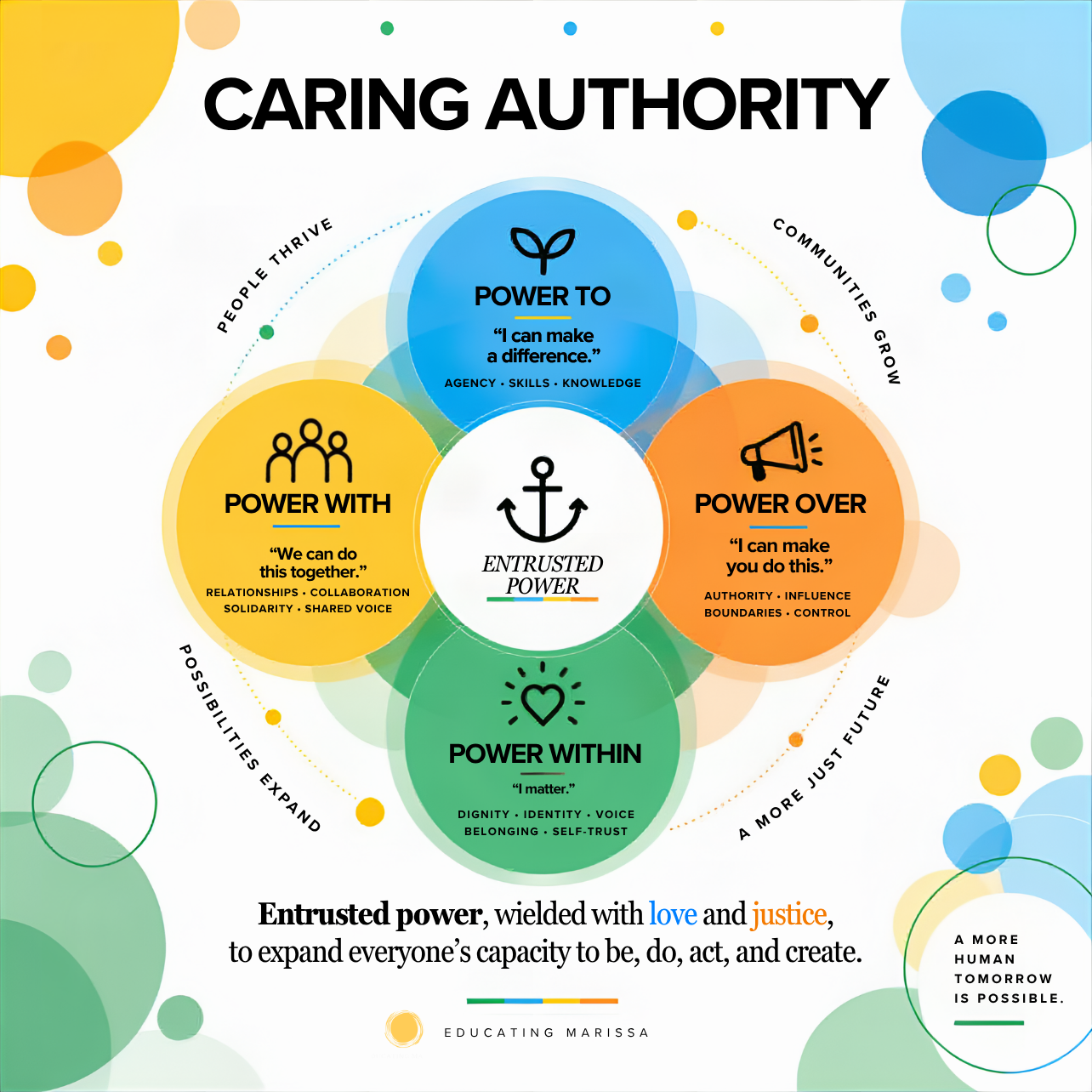
Once Power Is Seen, We Begin To Wield It Differently

Using Caring Authority that:

  • Treats authority as the gift & honor it is.

  • We use the power entrusted to us for the reason it was bestowed upon us to support others.

Caring Authority model: Entrusted Power at the center of Power To, Power With, Power Over, and Power Within

What Is Caring Authority?

Caring Authority creates welcoming, affirming, and accountable learning environments across all spaces, from classrooms to staff rooms. It treats authority as power entrusted for the greater good and requires intentional reflection on how that power is used.

Core Stances:

  • People are more than their worst moment.

    Dignity is non-negotiable and foundational to every interaction.

  • Accountability is necessary for belonging.

    True community requires taking responsibility and repairing harm.

  • Power dynamics expose the unseen.

    Examining power helps us uncover hidden barriers and support equity.

  • Relationships drive real change.

    Transformation happens through authentic human connection, not compliance.

  • Leadership demands clarity, compassion, and consistency.

    We lead with empathy while setting clear, reliable boundaries.

  • We do better together.

    Collaboration and collective effort build stronger communities.

A Real-World Example: The “Late To Class” Cycle

A high school enacts a strict zero-tolerance tardy policy. If a student is 2 minutes late, they are locked out, given an automatic detention, or sent to the main office.

The Unseen Power Dynamic

  1. 1

    Behavioral ProblemsBehavior

    A student who was late due to a delayed bus gets locked out. The teacher sees them coming and closes the door anyway. Frustrated by the immediate penalty, they argue with the teacher (using their innate Power Within to preserve their dignity), and security is called.

    The Power Reality: Power Over was used strictly as control. The student felt disempowered and humiliated, so their reaction escalated from simple lateness to a “behavior issue.”

  2. 2

    High Suspension RatesSuspension

    The argument escalates and the student receives a 2-day out-of-school suspension.

    The Power Reality: Authority relied on enforcement rather than repair. The system protected the rule, not the relationship, removing the student from access to learning entirely.

  3. 3

    Admin vs. Teacher CultureCulture

    Teachers feel forced to enforce a rigid rule they feel hurts relationships with their students, or they ignore it and get reprimanded by administration.

    The Power Reality: Teachers experience Power Over from leadership. They feel their professional judgment is stripped away, creating resentment toward admin.

  4. 4

    High Staff TurnoverTurnover

    Exhausted teachers leave the school at the end of the year, citing a culture of compliance over care.

    The Power Reality: When staff lack agency (Power To) and feel disconnected from leadership, burnout sets in quickly.

The Caring Authority Reframe

  • Don’t close the door on a student coming down the hall. Let them in. A quick, private conversation around expectations preserves dignity and uncovers critical context, like a late bus.
  • Don’t engage in power struggles. They produce no winners.
  • Suspension is for actual harm. Being late and losing class time is already a natural consequence. Locking a student out is a dignity violation that leads to escalation or retreat—both damaging to a student’s Power Within.
  • Teachers often handle things quietly behind closed doors. It seems harmless, but single classrooms don’t operate in a vacuum. When system rules strip away professional judgment, teacher agency and self-efficacy can take the hit.
  • Just because it’s working in your room doesn’t mean a student experiences the school as a healthy place. Pockets of safety are sometimes necessary, but they point to unaddressed systemic issues.
  • In a community, we are all responsible for outcomes.

The Four Expressions Of Power

Each expression has its own voice, its own facets, and conditions that help it grow or cause it to shrink.

Power Within

“I matter.”

Dignity
A deep sense that I am worthy of respect and I have a right to exist fully.
Identity
An understanding and appreciation of who I am, including my experiences, history, and values.
Voice
The belief that my perspective matters and I have the right to speak, be heard, and take up space.
Self-Efficacy
The belief that I can influence what happens, contribute, and make a difference.
Belonging
Feeling seen, valued, and connected. Knowing I am part of something.
Self-Trust
Confidence in my judgment, my voice, and my capacity to navigate challenges.
Possibility
The belief that I can learn, grow, make meaning, and contribute.

Grows Through

  • Respect and affirmation
  • Belonging and inclusion
  • Psychological safety
  • Meaningful voice
  • Opportunities to experience competence
  • Support, encouragement, and reflection

Shrinks Through

  • Humiliation, shame, and dehumanization
  • Exclusion and marginalization
  • Stereotyping and low expectations
  • Repeated failure without support
  • Environments that communicate that my voice does not matter

When Power Within is strong, people are more likely to learn, contribute, repair, and thrive.

Power To

“I can make a difference.”

Agency
The belief that I can make choices, take action, and influence my path.
Skills
The knowledge and abilities I develop to take effective action.
Knowledge
The information and understanding I need to make informed decisions.
Action
The willingness to follow through, try, persist, and take steps toward what matters.
Repair
The ability to reflect, learn, make amends, and try again.
Responsibility
Owning my role, my impact, and my commitments.
Choice
The ability to consider options and decide how I will respond.

Grows Through

  • Access to learning and resources
  • Encouragement and high expectations
  • Opportunities to practice and try
  • Support when I make mistakes
  • Clear goals and actionable feedback
  • Environments that build competence

Shrinks Through

  • Limited opportunities or access
  • Low expectations
  • Constant criticism or micromanagement
  • Fear of failure or punishment
  • Learned helplessness
  • Environments that discourage risk-taking

When Power To is strong, I move from possibility to action.

Power With

“We can do this together.”

Relationships
The connections, trust, and mutual care that make collective work possible.
Mutual Accountability
Holding ourselves and each other to high standards with care and transparency.
Trust
Believing in each other's intentions, showing up consistently, and building safety over time.
Collective Impact
Recognizing that we can go further together than we can alone.
Solidarity
Standing together, especially when it's difficult, to support justice and equity.
Shared Voice
Valuing diverse perspectives and creating space for everyone to be heard.
Collaboration
Working together, combining strengths, and sharing ideas to create solutions.

Grows Through

  • Open and honest communication
  • Respect for different perspectives
  • Opportunities to collaborate
  • Shared goals and shared success
  • Consistent support and follow-through
  • Equitable decision-making

Shrinks Through

  • Competition instead of collaboration
  • Exclusion and silencing
  • Mistrust or lack of transparency
  • Unfair distribution of power or credit
  • Individualism over collective well-being
  • Lack of follow-through

When Power With is strong, we build stronger communities, schools, and futures.

Power Over

“I can make you do this.”

Control
The desire to dictate outcomes, make the rules, and maintain power over people, situations, or resources.
Dominance
Prioritizing authority and influence over collaboration and shared decision-making.
Compliance
Seeking obedience rather than understanding, buy-in, or genuine engagement.
Fear
Using the possibility of punishment, exclusion, or negative consequences to influence behavior.
Manipulation
Influencing through guilt, pressure, or misinformation instead of honesty and respect.
Exclusion
Limiting access, opportunities, or voice to maintain advantage and silence dissent.
Inequity
Creating systems, policies, or practices that benefit some while disadvantaging others.

Grows Through

  • Transparency and accountability
  • Shared decision-making
  • Inclusive practices and access
  • Restorative responses instead of punishment
  • Recognizing and addressing power imbalances
  • Courage to challenge unjust systems

Shrinks Through

  • Secrecy and lack of accountability
  • Unquestioned authority
  • Punitive approaches
  • Silencing or dismissing others
  • Concentration of resources and opportunities
  • Environments that tolerate or reward coercion, fear, or manipulation

When Power Over is strong, people are less likely to feel safe, be themselves, or reach their full potential.

What is your current use of power making possible?